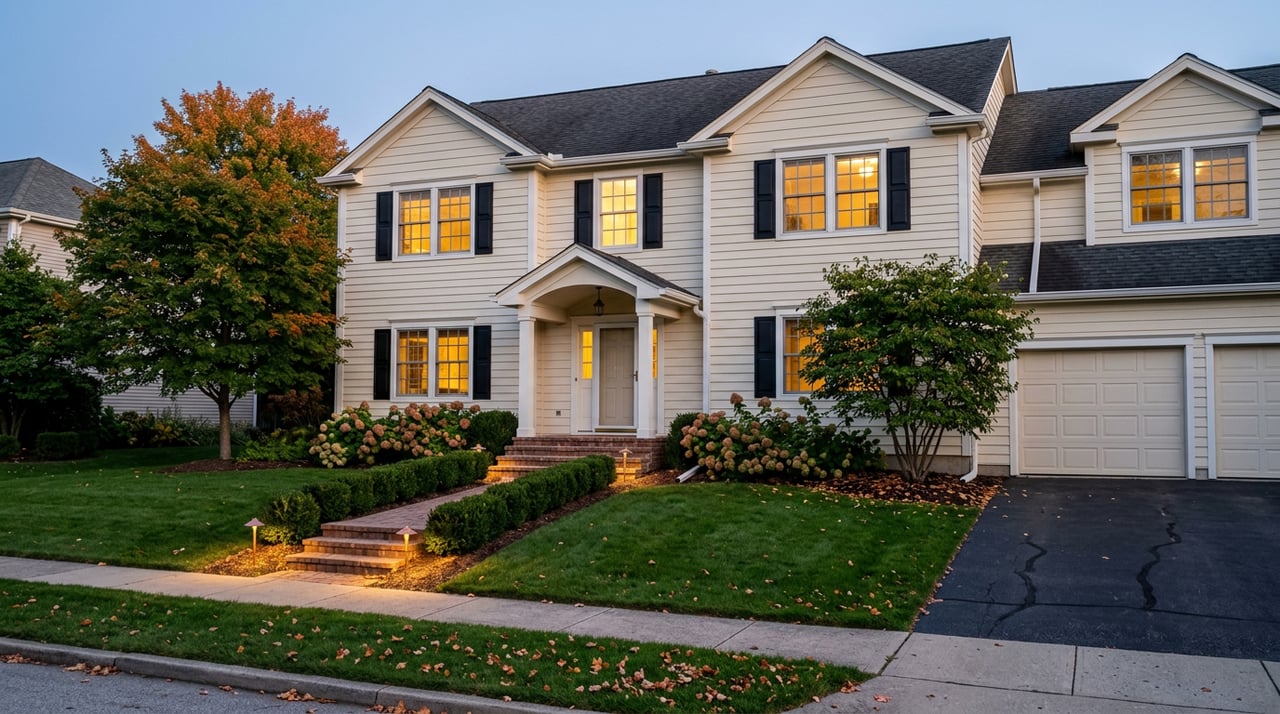
Picture two nearly identical colonials, both listed at $250,000, one in Manchester and one eight miles up Route 5 in South Windsor. Same square footage, same three bedrooms, same asking price on the same day. The buyer who only compares list prices will treat them as a coin flip. The buyer who checks what each town actually charges in property tax will find a gap, and that gap just got wider this spring.
According to CitizenPortal, in May 2026, Manchester's Board of Directors adopted its fiscal year 2026-27 budget and set the general fund mill rate at 41 mills, a 2.96-mill increase over the prior year. That's down from the town manager's original proposal, which would have raised the rate by 8.66 mills. The board trimmed roughly $9 million from that recommendation, including about $7.8 million cut from the Board of Education's request, before landing on a $253.9 million general fund budget with $127,983,133 earmarked for schools and $44,046,039 for public safety. If your property falls inside Manchester's Special Services District, add another 4.18 mills on top of the 41.
South Windsor went through its own version of this fight. Town Manager Michael Maniscalco initially proposed a mill rate of 38.09 for the same fiscal year, telling the Town Council the increase would push taxes on a $300,000 assessed home from about $10,683 to roughly $11,427. Patch quoted Maniscalco asking, "So everybody's sitting here going, what does that mean to me?" The council didn't take his number as final. South Windsor's adopted rate for FY2026-27 came in at 37.01, a full point below the proposal.
That means a Manchester buyer isn't just comparing one town's number against another. They're comparing a rate that grew this year against a neighboring rate that shrank from its own proposal. The list price on a portal was set months before either budget vote. The tax bill wasn't.
What the gap actually costs
Comparing the rates against the same assessed value shows the difference between towns.
The difference shows up in a property tax bill, even if it isn't displayed in a portal search. It reflects how each town chose to fund its schools and services this budget cycle, and it changes every time a new budget is adopted.
None of this means Manchester is a worse buy. A town with a higher mill rate isn't automatically more expensive to live in if the home itself costs less, and the two towns aren't identical products to begin with. It means the number a buyer sees first, the list price, is the one number in the entire transaction that doesn't reflect this year's budget votes at all.
Two housing markets under one median
There's a second layer to Manchester's pricing that a single median number flattens out entirely, and it has nothing to do with taxes.
Manchester spent the better part of a century as a company town built around the Cheney Brothers silk mills. The Cheney Brothers Historic District, a 175-acre National Historic Landmark on the town's south side, still contains more than 275 mill buildings and worker houses built between 1850 and 1920. Most of those structures never left residential use. Some became something else entirely.
Two examples make the point. Lofts at the Mills, at 91 Elm Street, is a converted mill building now operating as an apartment community with 15-foot ceilings and exposed brick and timber, the kind of industrial character a builder can't replicate in a new subdivision at any price. The National Park Service says the Dye House, a 1914 mill building that sat vacant for decades, was converted into 57 apartments in a $14 million rehabilitation that used federal and state historic tax credits and finished in 2009.
Neither of these is the housing stock most buyers picture when they hear "Manchester median price." That number, sitting somewhere between roughly $301,000 and $345,000 depending on the month and the source, is an average of ordinary postwar colonials and ranches, the standard suburban stock that carries the town's full residential tax burden with nothing to offset it.
The mill-village stock is a different asset entirely:
- It comes with exposed brick, timber framing, and ceiling heights a standard colonial doesn't have
- It typically carries an HOA fee on top of the property tax bill, since most units sit inside a converted building with shared systems
- It sits inside a National Historic Landmark district, which can mean added review for exterior changes depending on the specific property
A buyer shopping Manchester's median price without knowing this split is comparing two different products as if they were one. The colonial on a quarter acre and the loft in a converted silk mill can list for similar numbers and cost entirely different amounts to own month to month once HOA dues, insurance, and maintenance obligations are counted alongside the tax bill.
What this means if you're comparing towns
The lesson isn't to avoid Manchester. It's to stop treating a median price as a finished answer and start treating it as the beginning of a question.
Before comparing Manchester to a neighboring town on price alone, ask what fiscal year that town's current mill rate reflects and whether the budget behind it just went up, went down, or held steady. Ask whether the specific listing sits inside a special taxing district that adds mills on top of the base rate. And ask what kind of housing product you're actually looking at: standard suburban stock taxed at the full residential rate, or a converted mill unit that comes with its own HOA structure and its own set of considerations around exterior changes and shared building systems.
A buyer who runs those three questions before making an offer is doing something the median price on any listing site can't do for them.
Common questions about Manchester's tax picture
Does a higher mill rate always mean a higher total tax bill? Not on its own. The bill depends on both the rate and the assessed value. A lower-priced home in a higher-mill town can still owe less in raw dollars than a pricier home in a low-mill town. The comparison only works when you hold the assessed value constant.
Are the converted mill condos in the Cheney Brothers Historic District taxed at a different rate than the rest of Manchester? No. A unit in a converted mill follows the same town-wide mill rate as any other Manchester property. What differs is the added HOA fee most of these buildings carry, since a converted mill has shared roofs, elevators, and building systems that a standalone colonial doesn't.
Why did South Windsor's final mill rate come in lower than what was proposed? The town manager's original proposal cited rising education costs, debt service, and capital spending as the drivers behind the increase to 38.09. The Town Council held a public hearing before final adoption and the budget that emerged set the rate at 37.01 instead, a point lower than the initial ask.
If you're weighing Manchester against a neighboring town and want the current numbers run against a specific address, or you want to see which listings sit inside the standard residential stock versus the Cheney Brothers mill conversions, reach out to Peter Vamvilis. Start Your Home Search with someone who checks the budget vote, not just the list price.
This article is general information, not legal, tax or financial advice. Consult a qualified professional about your situation.
